
The cap (of skins, seeds, etc) fell this morning - meaning fermentation is either done or very close to being done. We immediately put an airtight lid on it, then sprayed in a bit of CO2 to protect the must. Now it's officially in extended maceration; will probably keep it that way until we press the Cab (this is in the name of efficiency: renting the press once is simply easier than renting it twice.)
While at it, we checked the Cabernet - it's still actively fermenting away, and is now down to 1/2 sugar depletion. That's a bit later than ideal to add Fermaid K, but we did at a slightly smaller amount: Should be 1 tsp / 7 gallons at 1/3 sugar depletion, BUT I added about 1 tsp / 10 gallons at 1/2 sugar depletion.
Thursday, October 14, 2010

Monday, October 11, 2010
Time for Yeast
24 hrs later, we pitched good ol' D254 by sprinkling the dry yeast on top of 72 degree must. I was worried it wasn't going to take off very well, but seemed to take off quite nicely. A mini-heatwave here in the Bay Area may have helped.
8 hrs later, we added our Malolactic Starter (Viniflora Oenos), this time we sprinkled on top and gently stirred it into the top inch or so of must.
By the next day (10/12), a nice cap of skins & seeds had formed, and it was clear that it was on its way to becoming wine.
8 hrs later, we added our Malolactic Starter (Viniflora Oenos), this time we sprinkled on top and gently stirred it into the top inch or so of must.
By the next day (10/12), a nice cap of skins & seeds had formed, and it was clear that it was on its way to becoming wine.
Sunday, October 10, 2010
Chapitalization = adding sugar
 Never thought we'd need to add sugar to our must, so we needed to get up-to-speed on the art of chapitalization. Not too surprisingly, we turned to the Web only to get a variety of advice and a mix of good and bad equations on how to figure out how much sugar to add.
My husband is a genius, however, and shared with me that the calculation is "super simple":
1. weigh the fermenter
2. subtract 5 lbs cuz that's what the bucket weighs
3. assume 80% of the weight is juice (this is the dodgy part, i'm just guessing)
4. to get sugar, multiple brix times weight: (0.20 * 84 lbs) = 16.8 lbs in the must
5. to get target sugar: (0.23 * 84 lbs) = 19.3 lbs
6 2.5 lbs = 19.3 - 16.8
Even simpler is to just multiply the difference: (sugar to add) = (target brix - current brix) * lbs of juice.
OK Cab Sauvingnon, your turn
Still a bit sad about this year's grape quality, but when life gives you under-ripe grapes, chapitalize!
Here's what we did with the Cabernet Sauvignon must:
 1. Separated into A and B (A is 15 gallons from the lower rows and higher quality; B is 10 gallons from the top rows, even less sweet / more acidic)
2. Added 50 ppm potassium metabisulfite
3a. To "A" - remember the 1.5 gallons of extra sweet juice we took off the Zin? That's right, we added that juice to A, hoping to bring the sugars up and acidity down. Re-measured and got 21.75 Brix; a bit lower than we like, so we decided to add 2 lbs of sugar to bring the must up to 23.75 Brix. Note that when we added the sugar, we actually stirred REALLY well, then let sit for a few hours, then stirred REALLY well again before testing. Sugar needs to fully dissolve, and we've read tales of winemakers that over-chapitalized his wine by not letting the sugar dissolve enough.
3b. To "B", we went straight to the sugar: added 3 lbs of sugar to bring the Brix up to 23 Brix.
4. Divided a 1-oz package of pectic enzyme up proprotionally between the two bins.
5. Added 2 tsp Fermaid K
6. Let sit until tomorrow.
Here's what we did with the Cabernet Sauvignon must:

2. Added 50 ppm potassium metabisulfite
3a. To "A" - remember the 1.5 gallons of extra sweet juice we took off the Zin? That's right, we added that juice to A, hoping to bring the sugars up and acidity down. Re-measured and got 21.75 Brix; a bit lower than we like, so we decided to add 2 lbs of sugar to bring the must up to 23.75 Brix. Note that when we added the sugar, we actually stirred REALLY well, then let sit for a few hours, then stirred REALLY well again before testing. Sugar needs to fully dissolve, and we've read tales of winemakers that over-chapitalized his wine by not letting the sugar dissolve enough.
3b. To "B", we went straight to the sugar: added 3 lbs of sugar to bring the Brix up to 23 Brix.
4. Divided a 1-oz package of pectic enzyme up proprotionally between the two bins.
5. Added 2 tsp Fermaid K
6. Let sit until tomorrow.
10/10/10 = 2010 Harvest Day
Exhausted from fending off critters that want to eat our crop, combined with a chance of rain later this week and less-than-optimal sun exposure this time of year, we decided to harvest today. A bit early, which is bad, but it IS 10-10-10, which I can't help but be happy about.
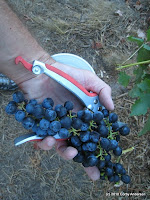
We're in our groove - sent that last-minute invite to friends that are known to enjoy picking grapes. Got started around 7:30am by removing the bird nets from the lowest row, picking them, repeating our way up the hill.
We walked away with about the same yield as last year - 30 gallons of must. But, our numbers were way worse. Our goal is to get to a sugar content of 23-25 Brix, and acid level of 6-7.5 TA.
Instead, the two batches were:
 Batch "A" (bottom rows mixed with unfermented Zinfandel juice):
21.75 Brix
9ish TA
Batch "B" (top rows, just grapes):
19.75 Brix
9ish TA
A bit surprised that the acids are so similar on both batches. We'll be deciding what to do with the grapes over the next 24 hours - stay tuned!

We're in our groove - sent that last-minute invite to friends that are known to enjoy picking grapes. Got started around 7:30am by removing the bird nets from the lowest row, picking them, repeating our way up the hill.
We walked away with about the same yield as last year - 30 gallons of must. But, our numbers were way worse. Our goal is to get to a sugar content of 23-25 Brix, and acid level of 6-7.5 TA.
Instead, the two batches were:
 Batch "A" (bottom rows mixed with unfermented Zinfandel juice):
21.75 Brix
9ish TA
Batch "B" (top rows, just grapes):
19.75 Brix
9ish TA
A bit surprised that the acids are so similar on both batches. We'll be deciding what to do with the grapes over the next 24 hours - stay tuned!
Sunday, October 3, 2010
Let's get the Zin started
We were not expecting the Zin must to be so high in sugar / low in acid - so here's what we did:
1. Combined the must into one Brute; there's about 17 gallons total
2. Removed 1.5 gallons or so of the free run juice
3. Added 2 quarts of water, to bring the sugar down to 26 brix. TA (0.64) & pH (3.9) stayed the same.
4. Added 10 tsp pectic enzyme (a bit more than the 1/2 tsp / gallon guideline)
5. Pitched 10g of D254 (1/3 of the packet) by sprinkling dry on top of 78 degree must
6. Waited 6 hrs
7. Added 2 tsp Fermaid K
8. Added Malolactic Starter (Viniflora Oenos)
Within a day, it was bubbling away; cap being pushed down at least 4x/day - we hear that's best, especially during primary fermentation (first 4-5 days).
1. Combined the must into one Brute; there's about 17 gallons total
2. Removed 1.5 gallons or so of the free run juice
3. Added 2 quarts of water, to bring the sugar down to 26 brix. TA (0.64) & pH (3.9) stayed the same.
4. Added 10 tsp pectic enzyme (a bit more than the 1/2 tsp / gallon guideline)
5. Pitched 10g of D254 (1/3 of the packet) by sprinkling dry on top of 78 degree must
6. Waited 6 hrs
7. Added 2 tsp Fermaid K
8. Added Malolactic Starter (Viniflora Oenos)
Within a day, it was bubbling away; cap being pushed down at least 4x/day - we hear that's best, especially during primary fermentation (first 4-5 days).
Saturday, October 2, 2010
Zin's in!
Picked up our Zinfandel must, this time from Murrill Vineyard, in the Sierra Foothills. After being worried that it's been too cool a year to properly ripen, the numbers actually look great! As reported by our broker:
Brix: 27.6 (wow!)
TA: 0.65
pH: 3.7
Immediately after crush, added just under 50ppm potassium metabisulfate to kill any native yeasts (used 1/4t per 5 gallons of must). Processing to start tomorrow.
Brix: 27.6 (wow!)
TA: 0.65
pH: 3.7
Immediately after crush, added just under 50ppm potassium metabisulfate to kill any native yeasts (used 1/4t per 5 gallons of must). Processing to start tomorrow.
Subscribe to:
Posts (Atom)